If you have been following the chess world recently, you have probably heard the term thrown around by top grandmasters, streamers, and commentators: Chess960. You might have seen Magnus Carlsen winning the 2026 FIDE Freestyle Chess World Championship, or noticed that your favorite chess app suddenly added a new game mode.
But what exactly is it? Why are the world's best players suddenly obsessed with a game where the pieces are scrambled? And more importantly, how can an amateur player learn to play it without getting crushed in the first ten moves?
In this guide, we will answer the question "What is Chess960?", explore the fascinating history of how Bobby Fischer invented it, and show you how to train for this unpredictable format using the Chess Coach: Learn & Play app.
What is Chess960? The Basic Rules
Chess960, also known as Fischer Random Chess or Freestyle Chess, is a chess variant where the starting position of the pieces on the players' home ranks is randomized.
The game is played on a standard 8x8 board with the exact same pieces as traditional chess. The pawns are placed on the second and seventh ranks exactly as they always are. However, the pieces behind the pawns (the rooks, knights, bishops, queen, and king) are shuffled randomly before the game begins.
To ensure the game remains fair and balanced, the randomization must follow three strict rules:
- Bishops on Opposite Colors: One bishop must be placed on a light square, and the other must be placed on a dark square.
- King Between Rooks: The king must be placed on a square somewhere between the two rooks. This ensures that castling is still possible.
- Symmetrical Setup: Black's starting position must perfectly mirror White's starting position. For example, if White's queen is on a1, Black's queen must be on a8.
If you calculate all the possible mathematical combinations that satisfy these three rules, you get exactly 960 possible starting positions. Hence the name: Chess960.
Because there are 960 different ways the game can start, it is impossible for players to memorize opening theory. Every game forces players to rely on raw calculation, creativity, and genuine chess understanding from move one.
The Bobby Fischer Revolution: Why Was It Invented?
To truly understand what Chess960 is, you have to understand the man who created it: Robert James "Bobby" Fischer.
Widely regarded as one of the greatest chess players in history, Fischer's 1972 World Championship victory over Boris Spassky captivated the globe. But after winning the title, Fischer largely disappeared from competitive chess. When he returned for a rematch against Spassky in 1992, he was deeply troubled by what the game had become.
Fischer believed that classical chess was being corrupted by opening preparation. Players were spending more time studying computer-generated lines and memorizing variations than developing genuine chess understanding. The most prepared player, not necessarily the most creative one, was winning.
Fischer moved to Budapest, and for nearly a year, he worked closely with Susan Polgar and Pal Benko to redesign the game [1]. His goal was to eliminate the dominance of opening theory and replace it with pure talent. He formalized the rules of what he called "Fischerandom Chess," ensuring that castling was preserved and bishops remained on opposite colors.
Fischer Random Chess was formally introduced to the public on June 19, 1996, in Buenos Aires, Argentina [1]. It was a revolutionary idea, but it would take decades for the chess world to fully catch up to Fischer's vision.
Why Freestyle Chess is the Biggest Trend in 2026
Today, Chess960 — now frequently branded as Freestyle Chess — has exploded into the mainstream. The reasons are both practical and philosophical.
The rise of powerful chess engines like Stockfish has changed competitive chess at the highest levels. Top grandmasters now arrive at the board having analyzed positions to depths of thirty or forty moves. Many classical games at the elite level have become exercises in memory. This has pushed players at every level toward formats where originality matters more than preparation.
In February 2026, FIDE organized the FIDE Freestyle Chess World Championship 2026 in Wangels, Germany, with a massive prize pool of $300,000 [2]. The tournament featured the world's best players, and Magnus Carlsen won the championship, defeating Fabiano Caruana in the final [2].
| Tournament | Year | Winner | Runner-Up |
|---|---|---|---|
| FIDE World Fischer Random Championship | 2019 | Wesley So | Magnus Carlsen |
| FIDE World Fischer Random Championship | 2022 | Hikaru Nakamura | Levon Aronian |
| FIDE Freestyle Chess World Championship | 2026 | Magnus Carlsen | Fabiano Caruana |
Chess960 is the only chess variant officially recognized by FIDE other than traditional chess [1]. It is no longer a fringe experiment — it is the future of competitive chess.
How to Train for Chess960: Testing the Chess Coach App
Knowing what Chess960 is and actually playing it are two very different things. When you sit down for your first game, the board looks chaotic. Your instincts from standard chess will betray you. You need a place to practice.
I tested the Chess960 features in Chess Coach: Learn & Play, available on both the App Store and Google Play. It is built specifically as a training tool, making it the perfect environment to learn Fischer Random.
Setting Up the Game
The Chess960 setup screen gives you complete control over every variable before the game begins.
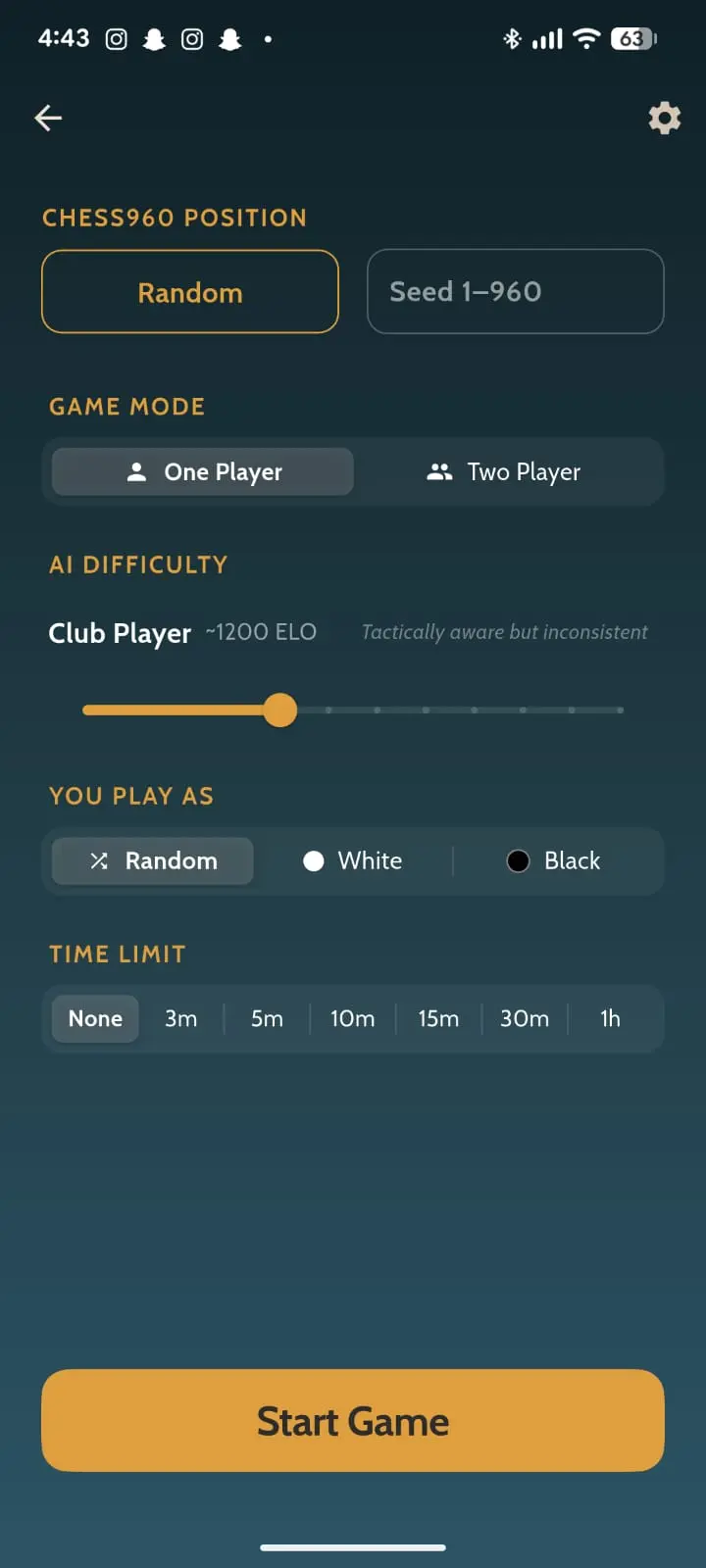
You can choose a completely random starting position, or manually input a specific seed number between 1 and 960. If you encounter a starting position that confuses you, you can replay that exact seed multiple times until you understand its strategic demands.
What makes this app exceptional for training is the ELO-based AI difficulty system. Instead of vague labels, the app uses actual ELO ratings. For this test, I set the difficulty to "Club Player ~1200 ELO," described as "Tactically aware but inconsistent." This is exactly the right level for practicing unfamiliar positions — strong enough to punish obvious blunders, but forgiving enough to let you experiment.
The In-Game Experience: Early Game
Once the game begins, the true challenge of Chess960 reveals itself. In the position I played, the starting setup placed the King on the g-file, flanked by rooks on either side, with the Queen tucked into the corner.
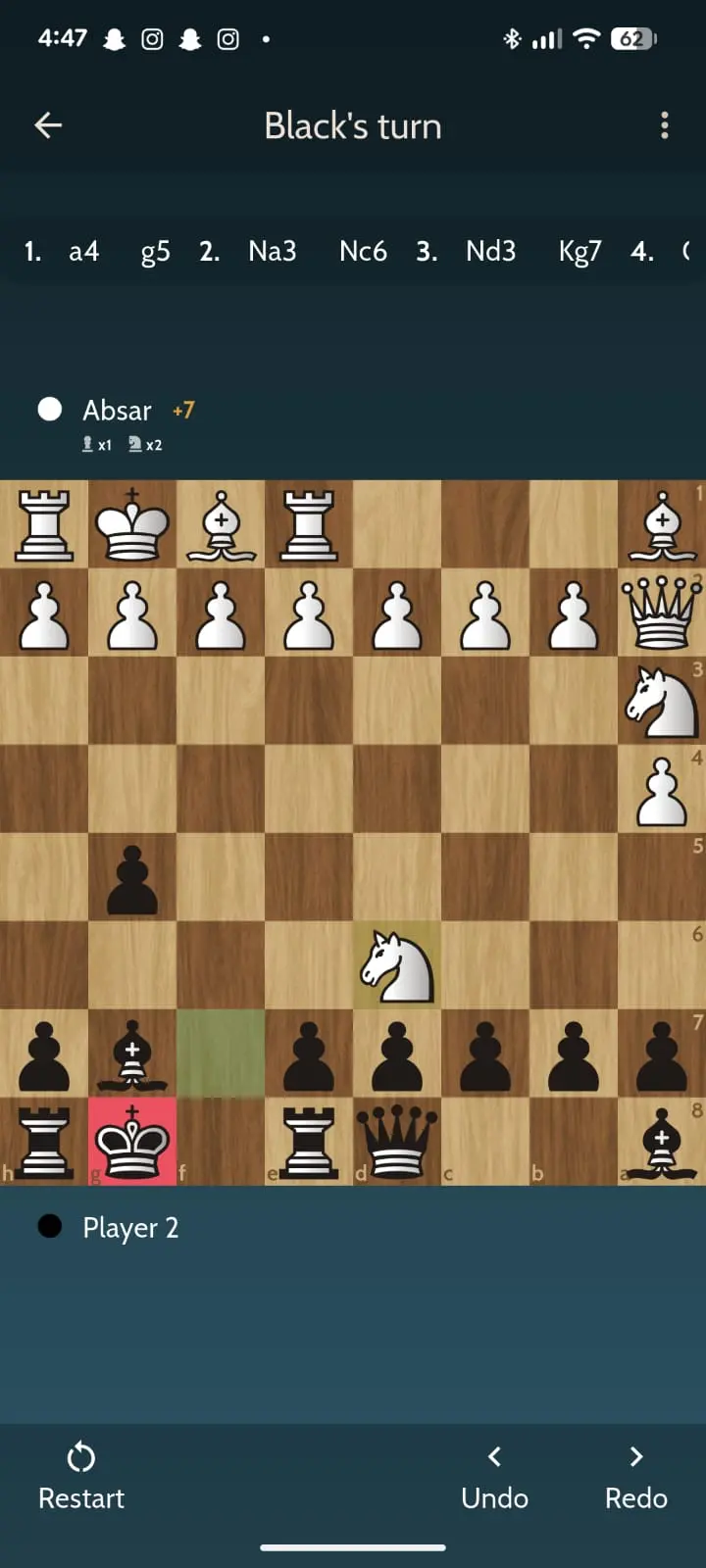
The app handles the complex, non-standard castling rules flawlessly. The move history scrolls across the top of the screen, and the real-time material advantage display (+7 for White in this game) is a genuinely useful feature that helps you keep track of the tactical chaos that often erupts in Chess960 middle games.
The In-Game Experience: Mid Game
As the game reached the middle phase, the tactical complications multiplied. The move sequence shown — Kg8, Qa2, Bg7, Nxf7, Nd6, Nxd6+ — demonstrates exactly the kind of sharp, creative play that Chess960 demands.
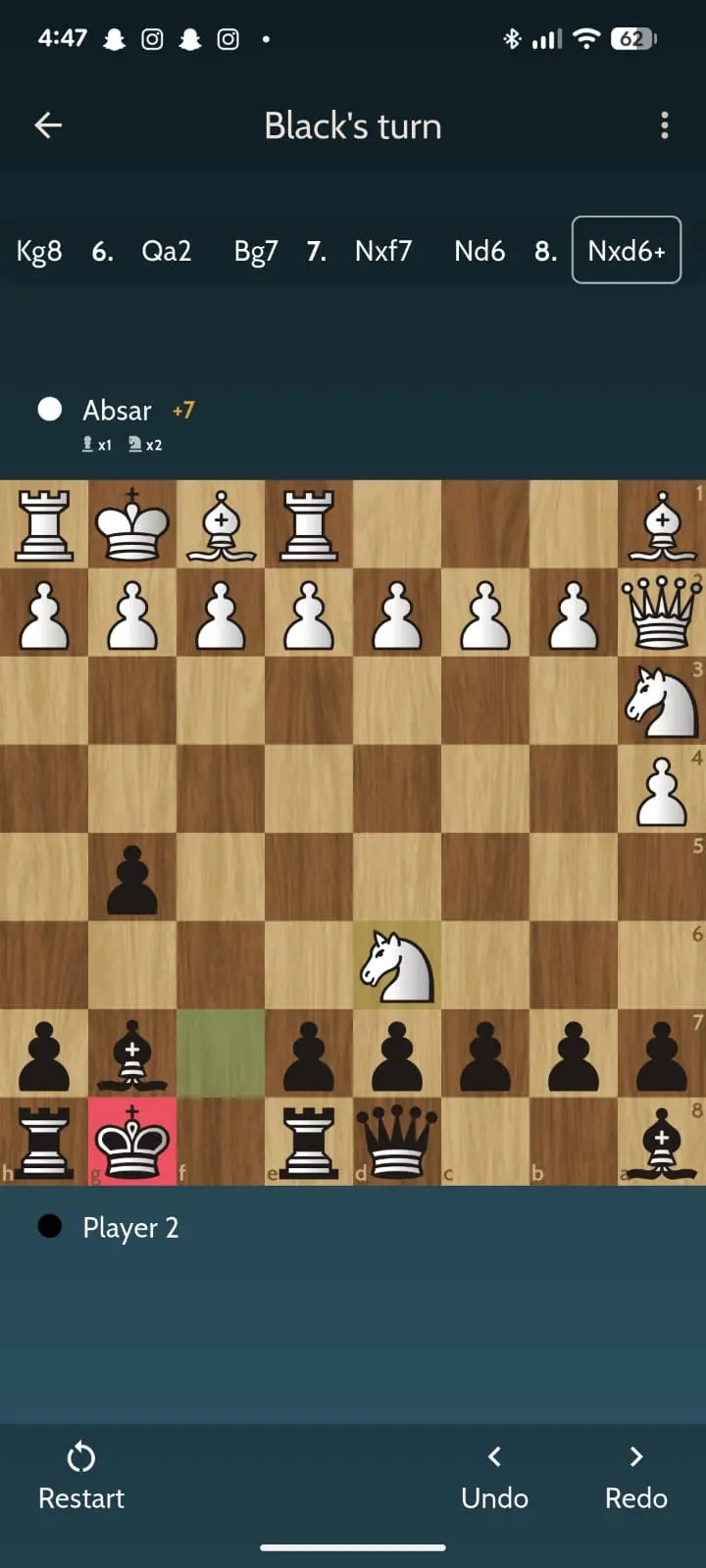
The Undo and Redo buttons at the bottom are essential for a learning environment. When you make a tactical blunder because you are not yet comfortable with a knight starting on d1 instead of b1, you can take it back and explore the position further without penalty.
Three Practical Lessons for Your First Chess960 Game
If you are just learning what Chess960 is and want to play your first game, keep these three practical lessons in mind:
Lesson 1: Prioritize King Safety Before Everything Else. Because the King often starts in exposed or unusual positions, your first priority must be securing it. Do not blindly push central pawns if doing so opens lines directly toward your own King. In standard chess, the King on e1 is relatively sheltered. In Chess960, it might start on b1, d1, or g1 — each requiring a completely different approach to safety.
Lesson 2: Scan for Undefended Pawns on Move One. In standard chess, all pawns are defended at the start of the game. In Chess960, central pawns might be completely undefended depending on the starting position. Before you make your first move, take thirty seconds to scan the entire board for immediate tactical vulnerabilities.
Lesson 3: Develop with Purpose, Not Habit. You cannot rely on your usual development schemes in Chess960. A knight might be better placed on the edge of the board depending on the randomized setup. Evaluate the position as it actually is, not as you wish it to be. This is the deepest lesson Chess960 teaches: genuine chess understanding, not pattern memorization.
Frequently Asked Questions
What is Chess960?
Chess960, also known as Fischer Random Chess or Freestyle Chess, is a chess variant where the starting position of the back-rank pieces is randomized. There are exactly 960 possible starting positions, making opening memorization impossible.
Who invented Chess960?
Chess960 was invented by former World Chess Champion Bobby Fischer, in collaboration with Susan Polgar and Pal Benko, in Budapest in the mid-1990s. It was formally introduced to the public on June 19, 1996.
How do you castle in Chess960?
Castling in Chess960 results in the exact same final king and rook positions as in standard chess (King on g1/c1, Rook on f1/d1 for White). However, because the king and rook start on different squares, the physical movement looks different. The king and rook simply jump to their standard castled squares, provided all normal castling rules (no pieces between them, king not in check, etc.) are met.
Is Chess960 officially recognized?
Yes. Chess960 is the only chess variant officially recognized by FIDE (the International Chess Federation) other than traditional chess. FIDE has organized official World Championships in 2019, 2022, and 2026.
Can I play Chess960 on the Chess Coach app?
Yes. Chess Coach: Learn & Play includes a full Chess960 mode with random or seed-based position selection, ELO-adjustable AI opponents, time controls, and real-time material tracking. It is available on Android and iOS.
Conclusions
What is Chess960? It is the realization of Bobby Fischer's vision: a version of chess where talent, calculation, and imagination matter more than rote memorization.
At the moment, Chess960 is no longer a niche variant. It is the fastest-growing format in competitive chess, supported by FIDE, played by the world's best players, and increasingly embraced by amateurs who want to rediscover the creativity that originally drew them to the game.
For the average player, the message is clear: if you want to improve at chess, you need to train your raw chess understanding, not just your opening knowledge. Chess960 is the most effective tool for doing exactly that.
Chess Coach: Learn & Play provides the focused, distraction-free environment you need to train for this format. The ELO-adjustable AI, the seed-based position selector, the real-time material tracking, and the clean training interface make it one of the best Chess960 training apps available on mobile today.
The future of chess is no longer just about memorization — it is about imagination. And imagination can be trained.
Download Chess Coach: Learn & Play Today


References
- International Chess Federation. "History of Chess960." FIDE, March 8, 2025. https://www.fide.com/history-of-chess960/
- Wikipedia. "FIDE Freestyle Chess World Championship 2026." https://en.wikipedia.org/wiki/FIDE_Freestyle_Chess_World_Championship_2026